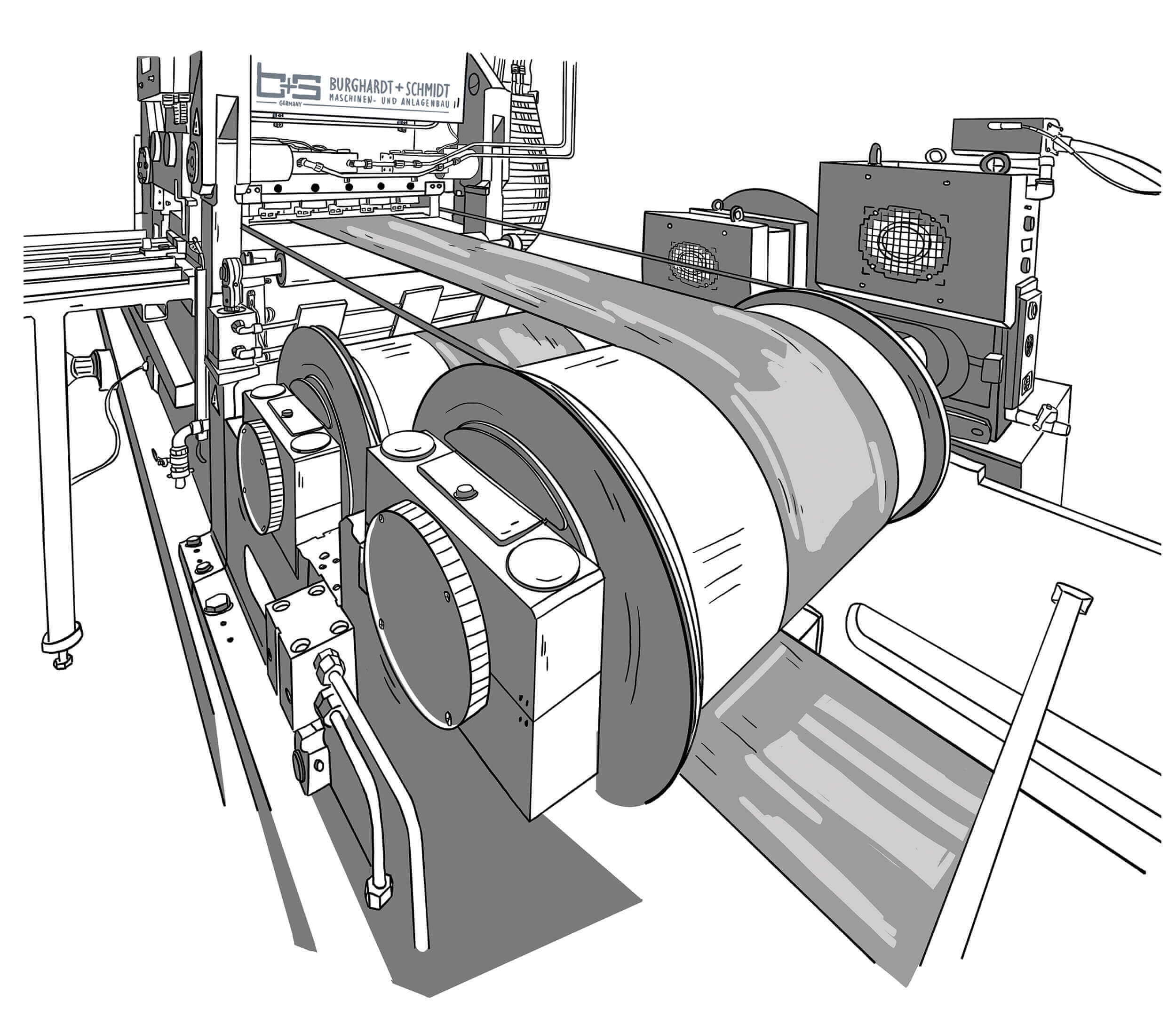


Precision Flatness for the Thinnest Strip Materials
Our Ultra-Thin Stretch-Bend-Leveling Lines for thin strip are specifically engineered for the demanding processing of thin and ultra-thin strip gauges — precisely where conventional roller leveling systems or conventional stretch bend leveling lines reach their limits. By combining targeted bending stress with defined tension force, the strip is uniformly deformed beyond its yield point and plastically flattened. The result: a level of flatness that cannot be achieved with classic leveling methods.
Operating Principle
Unlike pure roller or tension leveling, where the strip passes through alternating bending via multiple roller sets or 4-S-bridle rolls, Ultra-Thin Stretch-Bend Leveling Lines additionally applies a controlled longitudinal tension force with more S-bridle rolls. This combination ensures that internal stresses in the material — e.g. from coiling, rolling, or heat treatment processes — are fully and evenly relieved. This process delivers superior results, especially for high-strength, spring-hard, or spring-back-prone materials.
Typical Applications
- High-strength and ultra-high-strength steels
- Stainless and acid-resistant steel grades
- Spring steel strip and special alloys
- and non-ferrous metal strips
- Strip thickness range from thin to ultra-thin gauge (depending on configuration, starting at approx. 0.0004”/0.01 mm)
Core Components
- Uncoiler/payoff reel with precise strip guidance and tension control
- Stretch-bend leveler unit with multiple alternating bending rolls and servo-motor-adjustable bending radii
- Tension control stations (entry and exit side) for precise setting of stretch values
- Servo drive technology for highly dynamic, reproducible process control
- PLC control system (e.g. TIA Portal-based) with recipe-based parameter management for different materials and strip thicknesses
- Optional measuring and inspection systems for flatness, defects and thickness monitoring
Your Benefits
- Highest flatness quality, even for difficult-to-level, high-strength, or ultra-thin strips
- Reproducible results through recipe-controlled, servo-guided process parameters
- Reduced scrap and waste in downstream processing
- Fast changeover thanks to digital recipe management
- Robust, low-maintenance design for continuous industrial operation